Architecture planning
Choose infrastructure around workload and operational needs.

Technology & Development
Cloud Solutions in Bangladesh Secure, scalable cloud infrastructure built for growing businesses in Bangladesh. Modernize Infrastructure with Secure Migration, Architecture, DevOp…
Built for your business
A clear view of what we can bring to your project.
Choose infrastructure around workload and operational needs.
Plan the move from existing systems with clear dependencies.
Set up repeatable delivery and environment configuration.
Plan monitoring, access, and maintenance for the running system.
From conversation to delivery
Know what comes next,
at every step.
Agree on goals, requirements, and the people we are building for.
Shape the solution and review the approach together.
Develop in clear milestones with room for feedback.
Test the agreed scope and prepare your team for handover.
A closer look
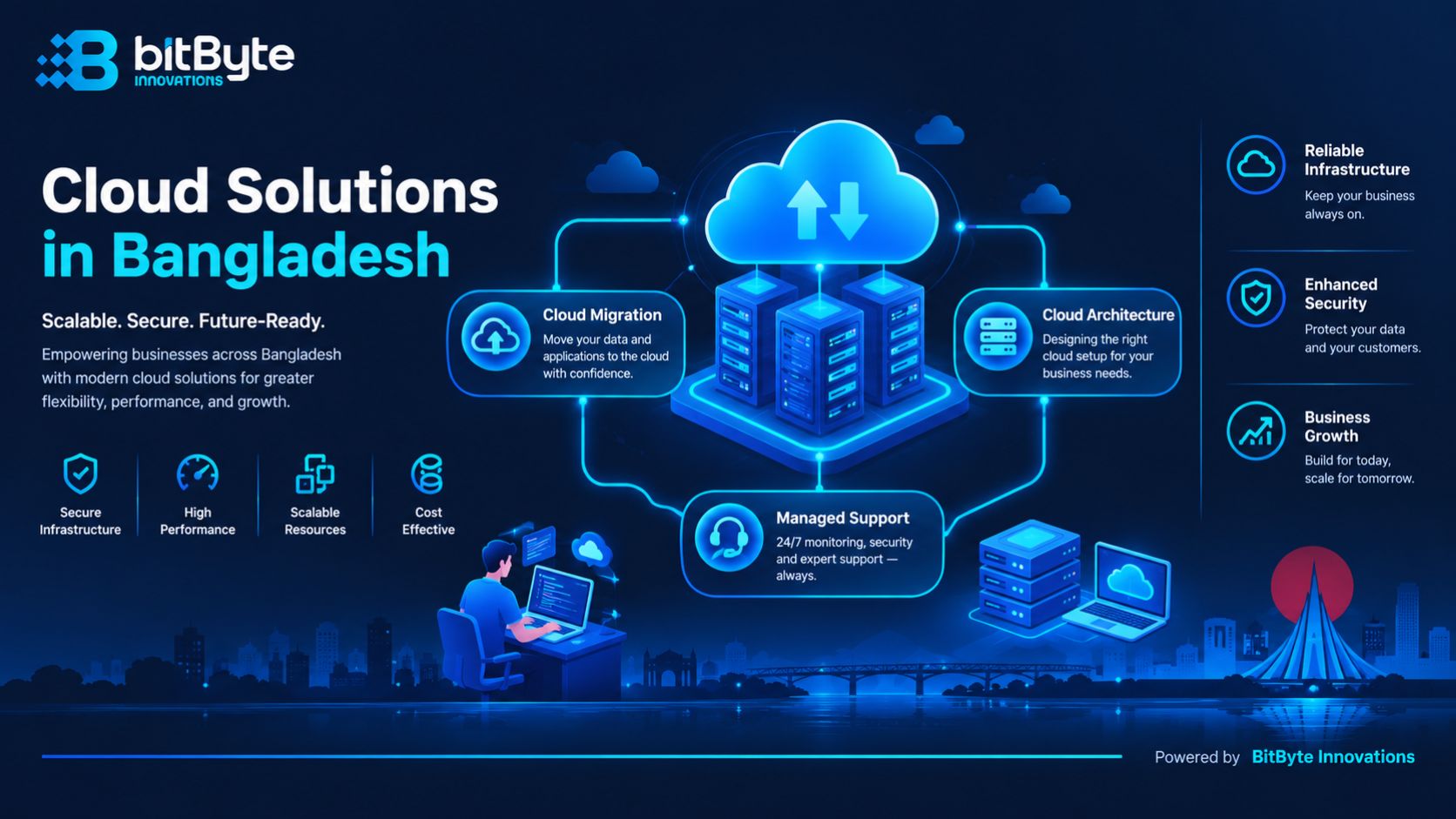
Cloud Solutions in Bangladesh usually get reduced to a single event: “we moved our server to the cloud.” That’s a migration, not a cloud strategy. A server sitting on AWS or Google Cloud without the right architecture, automation, or monitoring around it isn’t meaningfully different from the same server sitting in a local data center — except now it comes with a monthly bill that nobody is actively optimizing.
BitByte Innovations treats cloud as an ongoing capability, not a one-time move. Migration, architecture, DevOps, and managed support all work from the same infrastructure plan, so a business isn’t left with a cloud environment that works on launch day and quietly degrades — in cost, performance, or security — every month after.
This matters more than it sounds. A rushed “lift and shift” migration can leave a business paying cloud prices for on-premise-style inefficiency. Real cloud value comes from architecture decisions made before migration, not patched in afterward.
Most businesses that come to a cloud solutions provider in Bangladesh already have something running — a website, an app, an internal system — usually hosted on a single shared server with no redundancy plan. The problem isn’t always a lack of cloud adoption. It’s that the move to cloud infrastructure happened without a monitoring layer, a backup strategy, or anyone accountable for the monthly bill once the initial setup was done.
Connecting migration, architecture, and DevOps under one accountable team also means infrastructure decisions compound instead of conflicting. A well-designed cloud architecture makes automation easier to build. Automation, in turn, makes ongoing management faster and cheaper — rather than each stage being handled by a different vendor with no shared context of what came before.
Each of the following is a dedicated focus area within BitByte’s Technology & Development practice — not a single engineer managing every layer the same way.
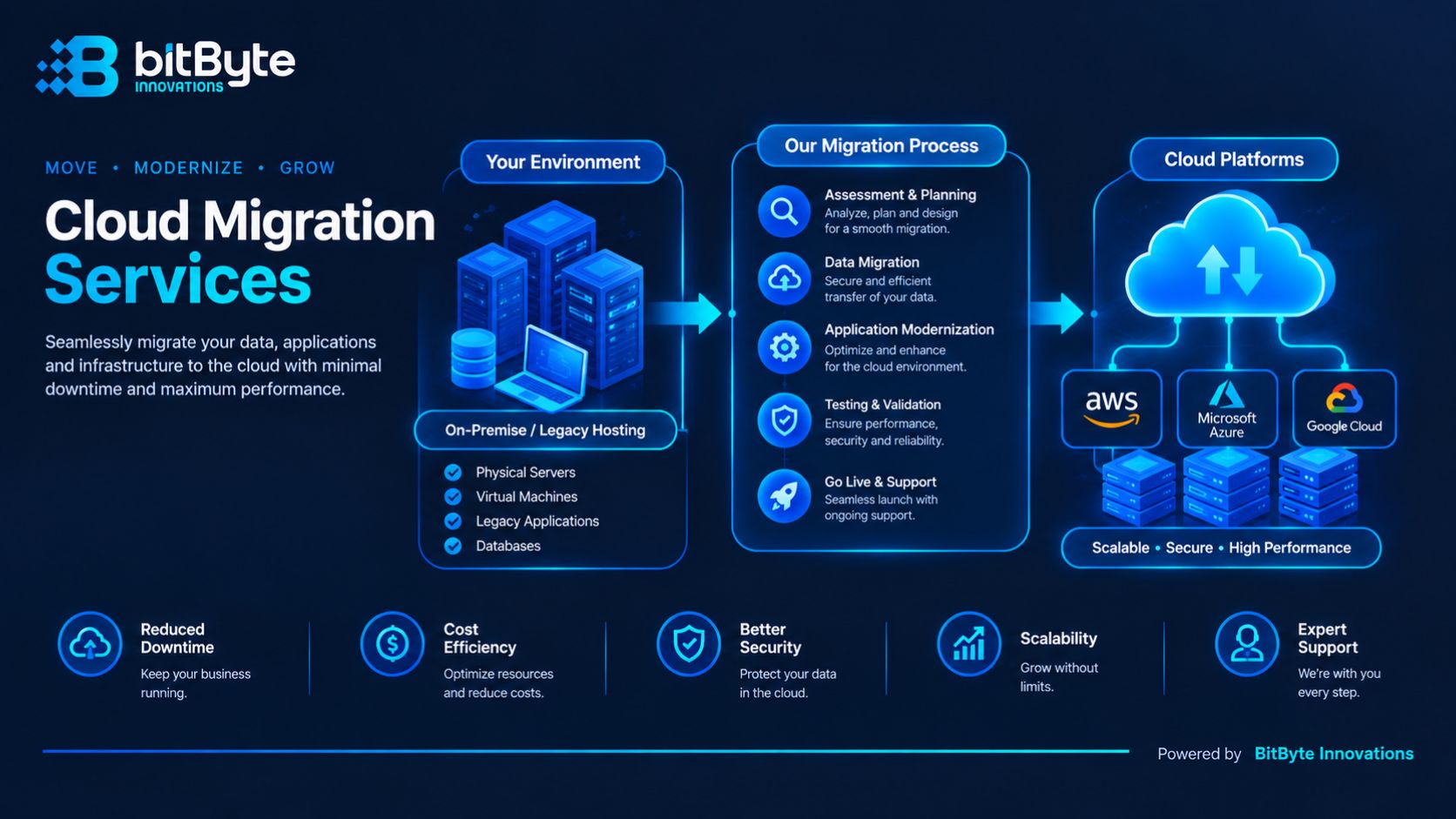
Moving applications, databases, and workloads from on-premise servers or underpowered hosting to scalable cloud platforms (AWS, Google Cloud, Azure) with minimal downtime. A migration plan accounts for data integrity, rollback options, and a defined cutover window — not just copying files to a new server and hoping nothing breaks.
Designing infrastructure around how a business actually operates — traffic patterns, growth plans, budget constraints, and compliance needs — rather than defaulting to a generic template. The right architecture for a seasonal e-commerce spike looks nothing like the right architecture for a steady-traffic B2B platform, even if both run on the same cloud provider.
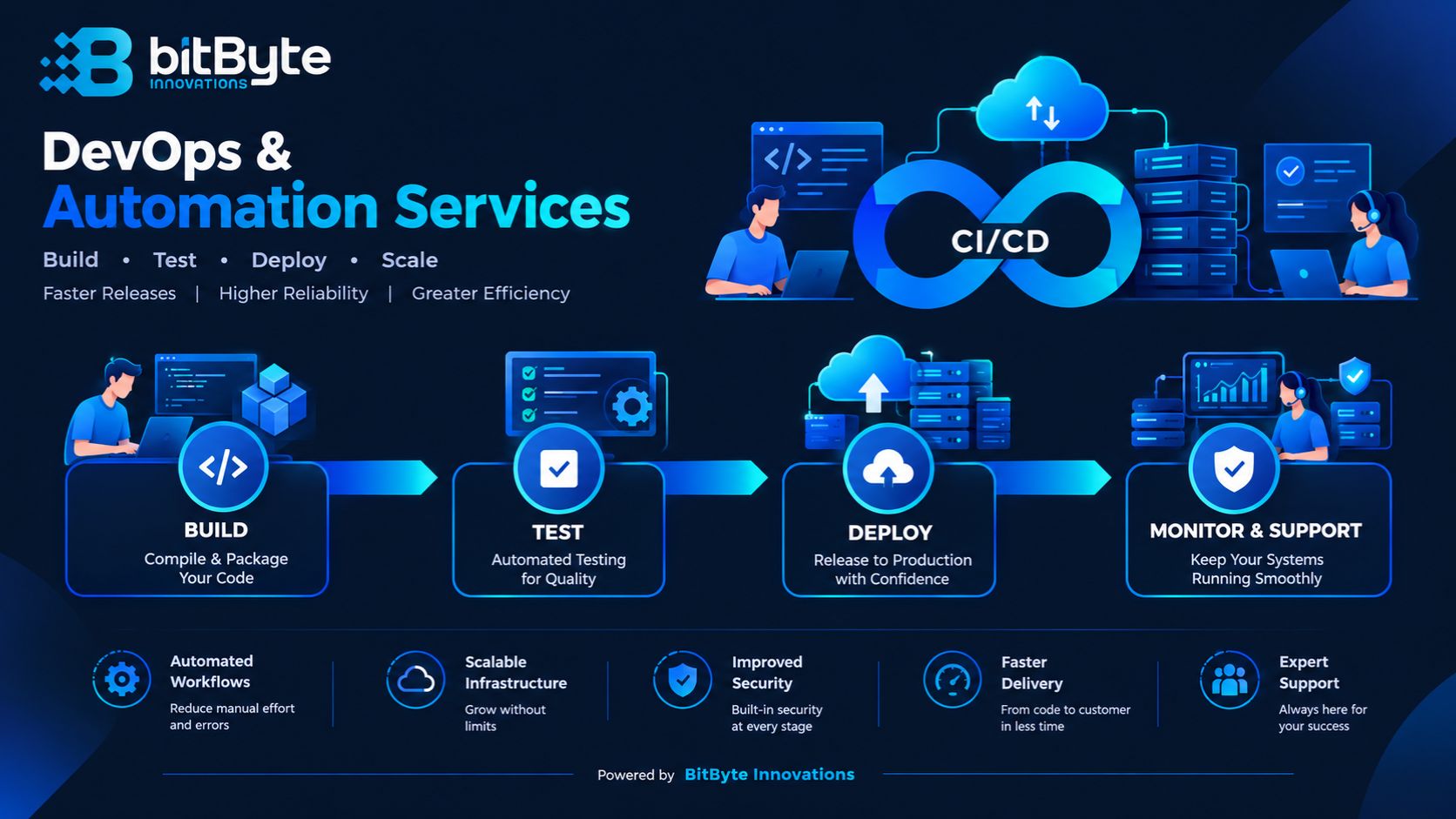
Building CI/CD pipelines, Infrastructure as Code, and automated deployment workflows that let a development team ship changes reliably instead of manually configuring servers each time. This is where a lot of the ongoing cost and reliability gains actually come from — automation that reduces human error, not just faster deployment for its own sake.
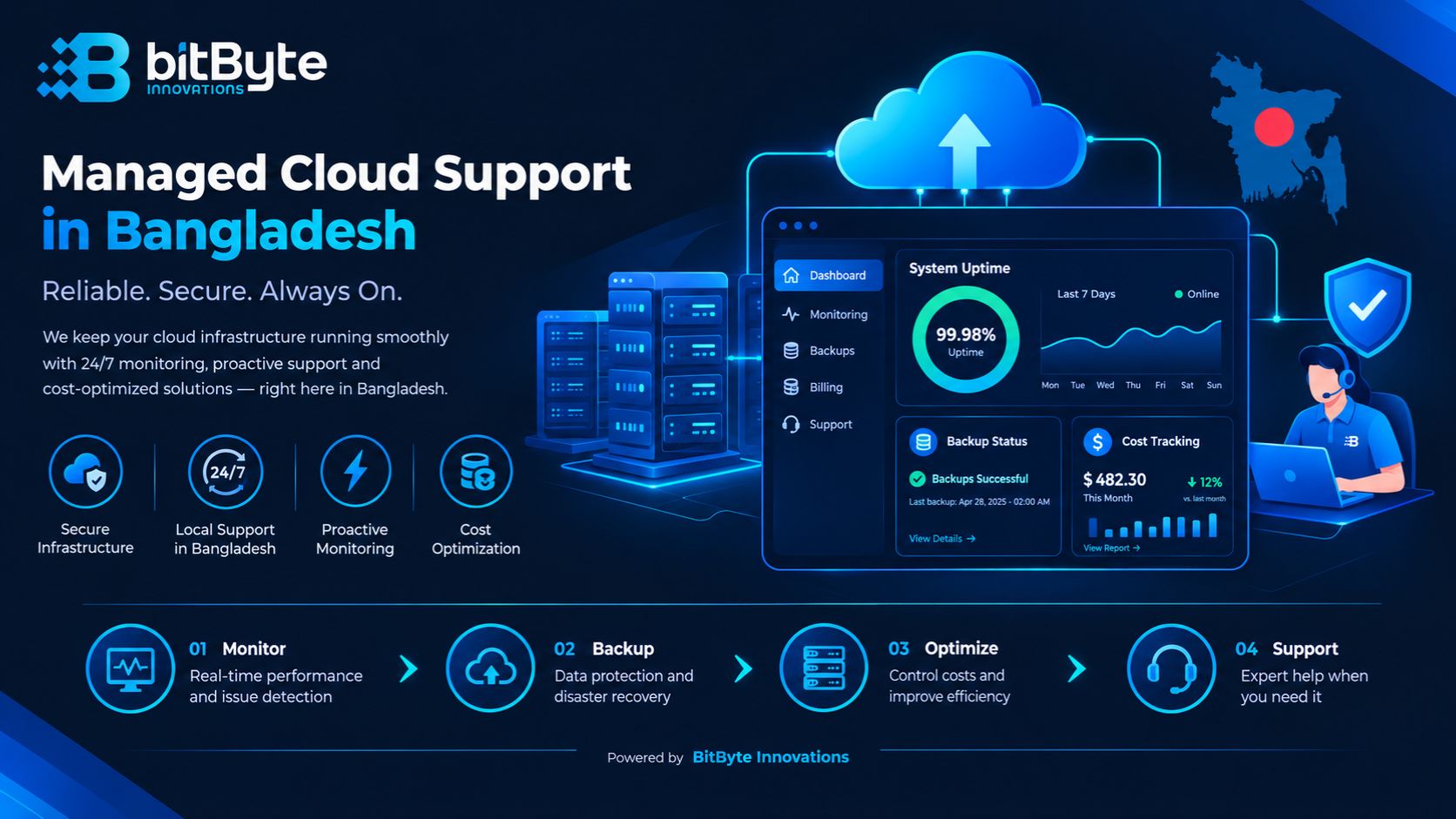
Ongoing monitoring, security patching, backup verification, and cost optimization after go-live. A cloud environment that isn’t actively managed tends to drift — unused resources keep billing, security patches fall behind, and nobody notices a backup has been silently failing until it’s needed.
A generic hosting provider typically sells a server and treats the relationship as done. A connected cloud partner uses what’s learned during migration to inform the architecture, and uses the architecture to decide what’s worth automating first. Managed support, in turn, feeds real usage data back into future architecture decisions — which workloads are growing, which resources are sitting idle, and where the next cost or performance issue is likely to show up.
This is what dependable cloud infrastructure actually looks like in practice. It’s not about running on every available cloud service regardless of fit. It’s about designing the specific combination of migration, architecture, automation, and support a business genuinely needs — with one team accountable for how it performs together, not four vendors pointing at each other when something breaks.
We deliver cloud solutions in Bangladesh for e-commerce, fintech, healthcare, education platforms, SaaS products, and B2B enterprise software. We weight the four solution areas differently depending on what each industry’s infrastructure actually needs.
An e-commerce platform, for instance, typically prioritizes auto-scaling architecture for traffic spikes and checkout reliability, while a fintech or healthcare platform leans heaviest on security hardening, compliance, and audit-ready logging. The right cloud approach depends entirely on what the business is protecting and what happens if it goes down.
BitByte Innovations has delivered 50+ projects for 25+ clients over 5+ years, with a 100% client satisfaction record. Unlike a hosting reseller that stops at server setup, our team also builds the custom software and cybersecurity foundation that infrastructure ultimately needs to run safely. We also connect cloud work directly with our broader digital transformation engagements for businesses modernizing more than just their servers.
Our Chattogram head office and Dhaka-facing operations give us direct familiarity with regional connectivity, hosting costs, and compliance expectations that a purely offshore provider often misses. Review our portfolio for examples of this work, or explore our full Technology & Development practice.
Do I need to migrate everything to the cloud at once? No. Most engagements start with the highest-impact workload — usually the one causing the most downtime or cost pain — and expand from there. A phased migration reduces risk and lets the architecture prove itself before scaling up.
What’s the difference between cloud migration and managed cloud support? Migration is the move itself — getting workloads onto cloud infrastructure safely. Managed support is what keeps that infrastructure secure, cost-efficient, and reliable afterward. Skipping the second one is how businesses end up with cloud bills nobody can explain.
Which cloud providers do you work with? We work across AWS, Google Cloud, and Azure, and recommend the provider — or combination of providers — based on workload requirements, budget, and where a business’s users are actually located, rather than defaulting to one platform for every client.
How do you measure success on a cloud engagement? Every engagement is measured against defined uptime, performance, and cost targets set during the design phase — not just “migration completed.” Where relevant, we also track deployment frequency and incident response time as automation matures.
Can you take over infrastructure someone else set up, or only build from scratch? Both. Most engagements start with an infrastructure audit of what’s already running, then build improvements from there rather than rebuilding unnecessarily.
Ready to stop treating cloud as a one-time move and start running it as a managed capability? Discuss your cloud strategy with BitByte Innovations →
Let’s make it happen
Tell us where you want to go. We’ll help you plan the next step.