Workflow discovery
Map current processes, tools, and bottlenecks.
Technology & Development
Digital Transformation Services in Bangladesh A practical roadmap for modernizing processes, platforms, and customer experiences Digital transformation services in Bangladesh usua…
Built for your business
A clear view of what we can bring to your project.
Map current processes, tools, and bottlenecks.
Sequence improvements around business priorities.
Connect the tools that need to exchange information.
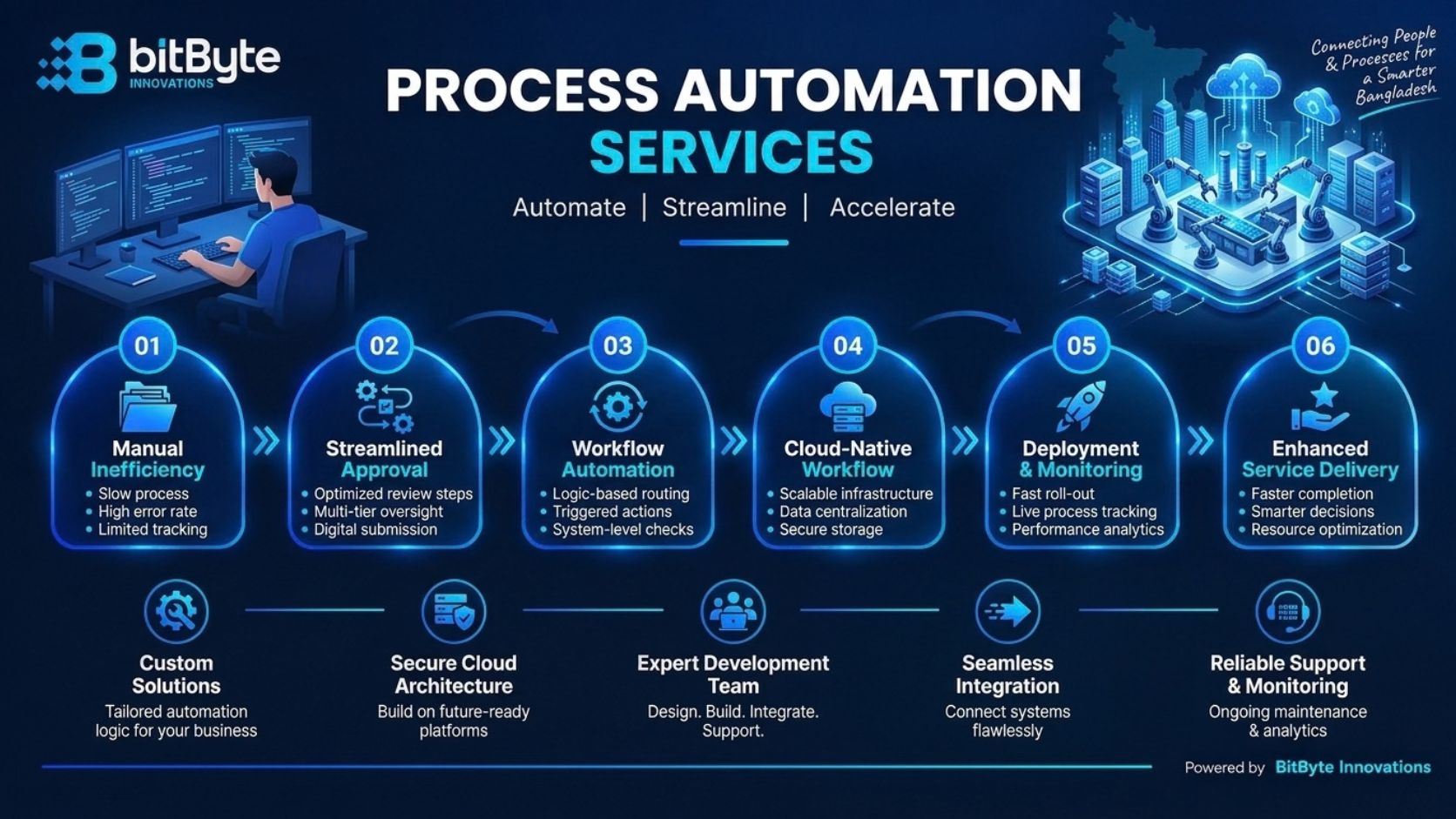
Identify repeated tasks that can become dependable workflows.
From conversation to delivery
Know what comes next,
at every step.
Agree on goals, requirements, and the people we are building for.
Shape the solution and review the approach together.
Develop in clear milestones with room for feedback.
Test the agreed scope and prepare your team for handover.
A closer look
Digital transformation services in Bangladesh usually get treated as a rebrand of “buying new software.” A business adopts a project management tool, moves files to Google Drive, and calls the transformation complete. The tools changed. The underlying process — who approves what, how information moves between departments, how a customer actually gets served — often didn’t.
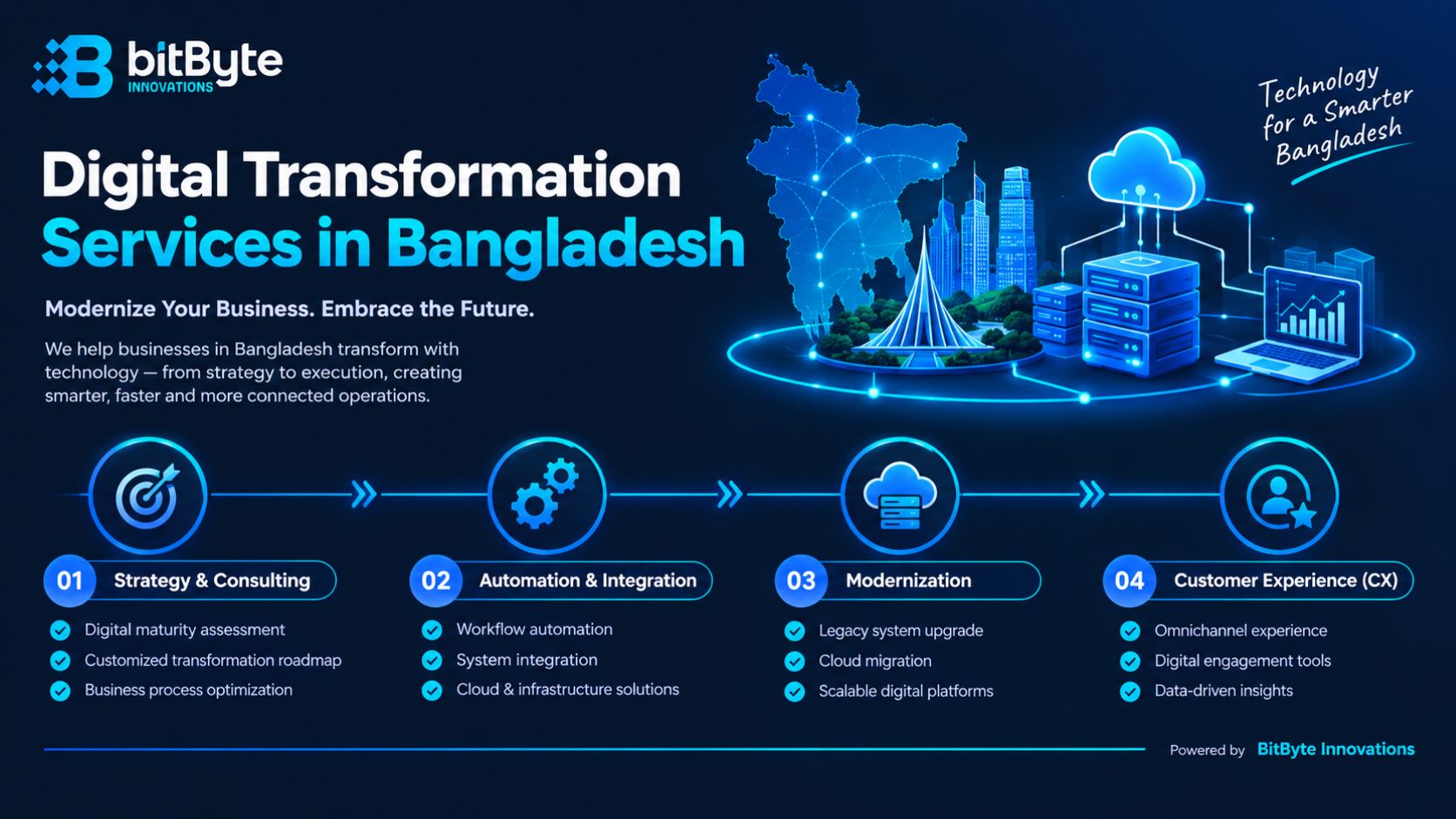
BitByte Innovations treats digital transformation as a change to how a business actually operates, not a shopping list of new platforms. Strategy, process automation, legacy modernization, and customer experience work all run from the same roadmap, so a business isn’t left with new software layered on top of the same manual bottlenecks that existed before.
This distinction matters more than it sounds. A business can spend months rolling out new tools and see almost no efficiency gain, because the process the tool was meant to fix was never actually redesigned — just moved from paper, or from spreadsheets, into a nicer interface.
Most businesses that come to a digital transformation partner in Bangladesh already have some technology in place. The problem usually isn’t a complete absence of tools. It’s that adoption happened piecemeal — one department picked a tool, another kept using paper, and nothing was designed to work together or scale as the business grew.
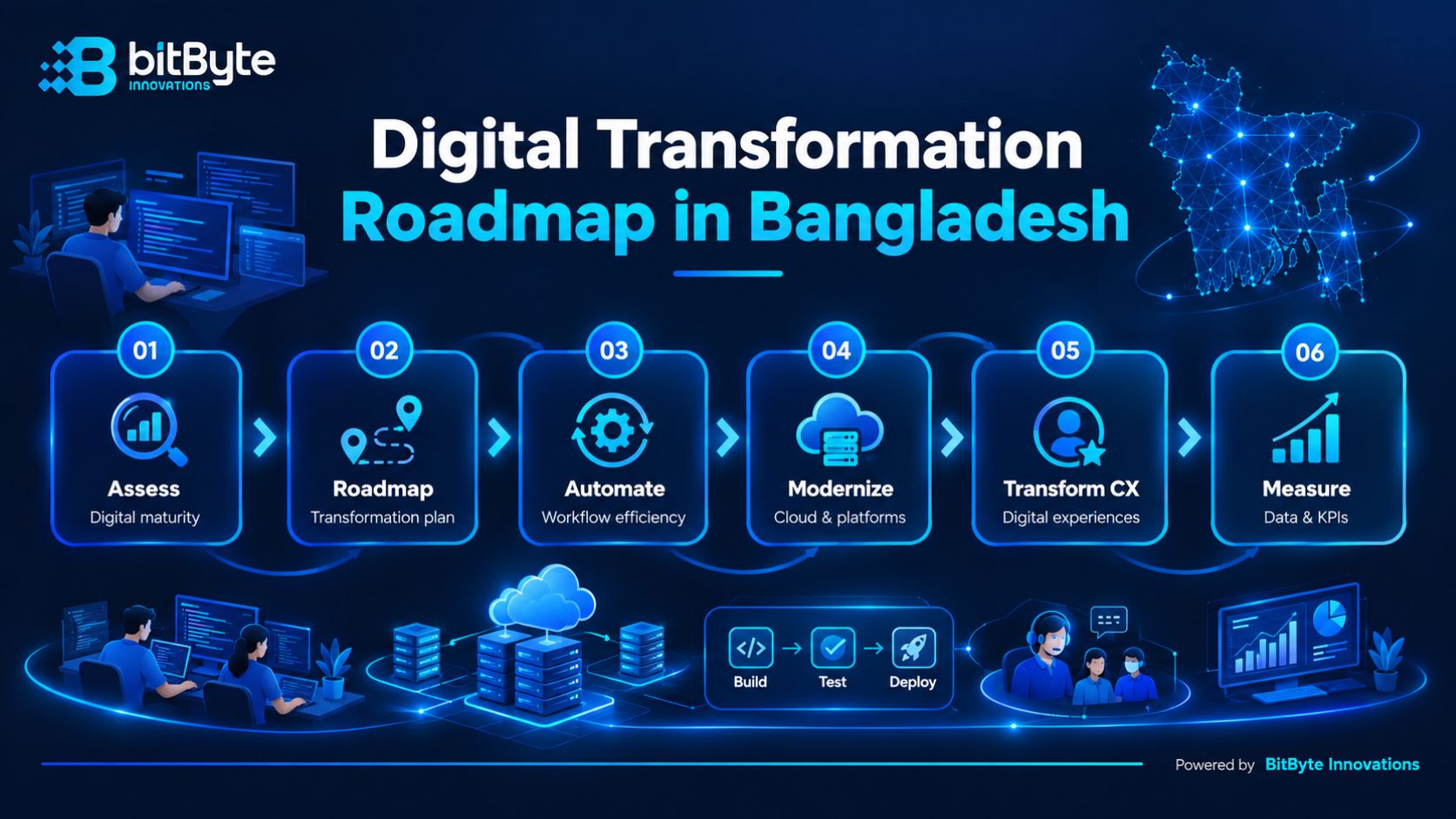
Starting from a roadmap instead of a tool list means every subsequent decision has context. A process automation project makes more sense once there’s a defined priority order of which manual bottleneck actually costs the business the most. A legacy system replacement is easier to justify once there’s a clear picture of what it’s currently costing in workarounds and lost time.
Each of the following is a dedicated focus area within BitByte’s Technology & Development practice — not a single consultant recommending the same playbook to every client regardless of what they actually need.
Assessing current systems, workflows, and pain points to build a prioritized transformation plan — what to fix first, what can wait, and what the expected return actually looks like. A roadmap gives a business a defined sequence instead of trying to modernize everything simultaneously and running out of budget or momentum halfway through.
Replacing manual, paper-based, or spreadsheet-driven processes with automated workflows — approvals, reporting, inventory tracking, customer onboarding — that reduce errors and free up staff time for higher-value work. The goal isn’t automation for its own sake; it’s removing the specific bottleneck that’s actually slowing the business down.
Replacing or integrating outdated software, disconnected spreadsheets, or unsupported systems with modern platforms that scale with the business and connect to the rest of the technology stack. A legacy system that “still works” often carries hidden costs in manual data re-entry and reporting delays that only become visible once they’re measured.
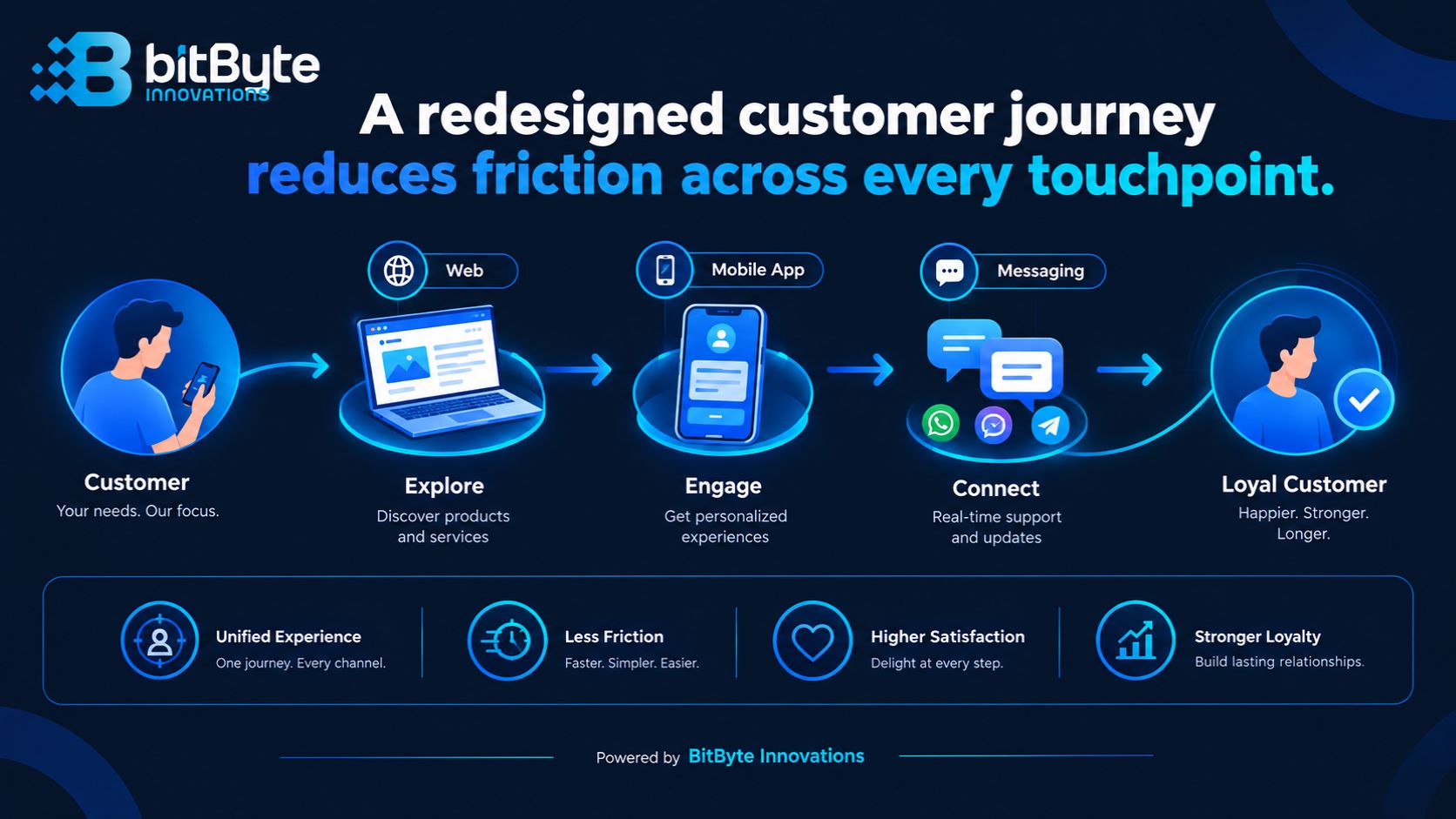
Redesigning how customers interact with a business across web, mobile, and messaging touchpoints — reducing friction in how they discover, purchase from, and get supported by the brand. A digital transformation that only improves internal operations while leaving the customer-facing experience unchanged captures half the available value.
A generic software vendor typically sells one tool and moves on to the next client. A connected transformation partner uses the roadmap assessment to decide which process to automate first, uses that automation work to expose which legacy systems are the real bottleneck, and uses what’s learned internally to inform how the customer-facing experience should actually change.
This is what practical digital transformation looks like in practice. It’s not about adopting every available platform regardless of fit. It’s about sequencing the specific combination of strategy, automation, modernization, and customer experience work a business genuinely needs — with one team accountable for how it performs together, not a stack of disconnected software licenses nobody is getting full value from.
We deliver digital transformation services in Bangladesh for retail, manufacturing, education, healthcare, financial services, and B2B enterprise businesses. We weight the four focus areas differently depending on what each industry’s operations actually require.
A manufacturing business, for instance, typically prioritizes process automation and legacy ERP modernization, while a retail or education business often leans heaviest on customer experience transformation across web and mobile. The right sequence depends entirely on where the business is actually losing time or customers today.
BitByte Innovations has delivered 50+ projects for 25+ clients over 5+ years, with a 100% client satisfaction record. Unlike a generic software vendor selling a single tool, our team also builds the custom software and cloud infrastructure that a transformation roadmap ultimately depends on to run reliably. We also connect transformation work directly with our AI solutions practice for businesses ready to layer automation and analytics on top of a modernized foundation.
Our Chattogram head office and Dhaka-facing operations give us direct familiarity with how local businesses actually operate day to day — which matters more for a transformation roadmap than a generic international framework applied without local context. Review our portfolio for examples of this work, or explore our full Technology & Development practice.
Do we need to transform every department at once? No. Most engagements start with the single process or system causing the most measurable cost or delay, and expand from there. Trying to transform everything simultaneously is usually how transformation projects stall out.
What’s the difference between digital transformation and just buying new software? New software is a tool. Digital transformation redesigns the underlying process the tool is meant to support — otherwise the same bottleneck just moves into a nicer interface without actually going away.
How long does a typical digital transformation roadmap take to show results? It depends on scope, but most engagements are designed to show measurable improvement on the first prioritized process within 8–12 weeks, with the full roadmap unfolding in phases over several months.
How do you measure whether a transformation actually worked? Every engagement is measured against defined efficiency, cost, or experience targets set during the roadmap phase — not just “new system is live.” We track what actually changed for the business, not just what was installed.
Can you work with systems and processes we already have, or only build from scratch? Both. Most engagements start with an audit of what’s already in place, then build improvements from there rather than replacing working systems unnecessarily.
Ready to turn scattered tools into one connected transformation roadmap? Discuss your digital transformation strategy with BitByte Innovations →
Let’s make it happen
Tell us where you want to go. We’ll help you plan the next step.